title: A closer look at the soup
gradient: top_bottom black blue
# A closer look at the soup
Matt's soup from orbit:
* It's omnipresent
* It's omnitenerent (except possibly trans fats)
* ...and that's it.
Note that while no concepts were irrevocably harmed in preparation of this presentation it does contain egregious abuse of notation and graphic scenes of undefended asymptotes.
# Coming closer
 # And closer
 # .
# .
 # Better, but we're still not there yet.
 # Ah, here we are.
 # A brief refresher course
* Vectors have a geometric interpretation
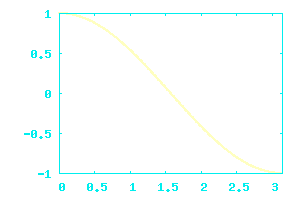
* a⋅b = |a|⋅|b|⋅cos(θ) = Σai⋅bi
- a⋅a = |a|2 = square of the length
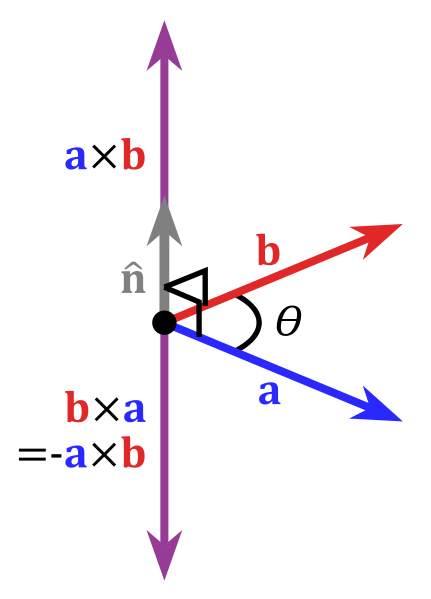
* a×b = |a|⋅|b|⋅sin(θ)⋅(_a unit vector perpendicular to both a and b_)
- Meaningless for n < 3
- Coals to Newcastle for n > 3
* Integral of a distribution
# Start with simple vectors
* One element in the range -1.0..1.0
# A brief refresher course
* Vectors have a geometric interpretation
* a⋅b = |a|⋅|b|⋅cos(θ) = Σai⋅bi
- a⋅a = |a|2 = square of the length
* a×b = |a|⋅|b|⋅sin(θ)⋅(_a unit vector perpendicular to both a and b_)
- Meaningless for n < 3
- Coals to Newcastle for n > 3
* Integral of a distribution
# Start with simple vectors
* One element in the range -1.0..1.0
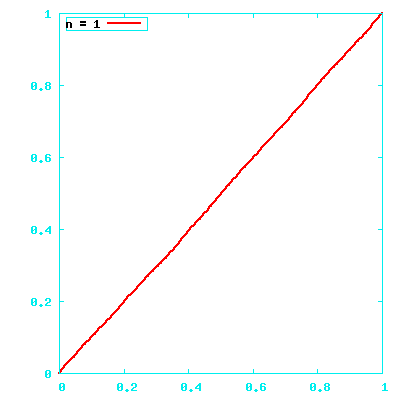
|a| will be uniformly distributed over 0.0..1.0
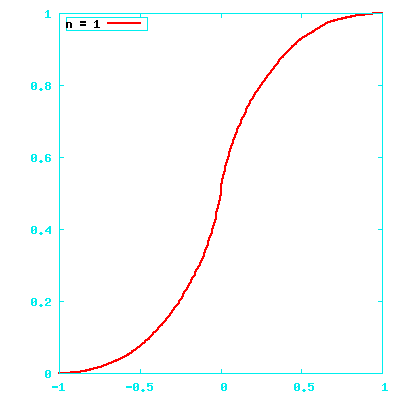
a⋅b/|a||b| ≈ 2⋅a⋅b
# For two dimensions
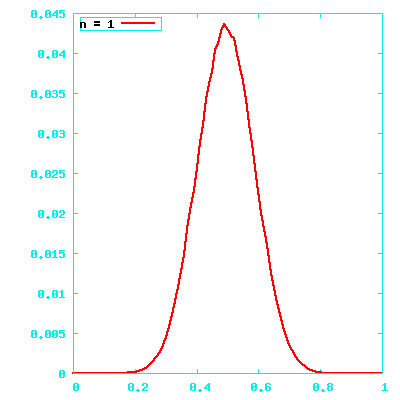
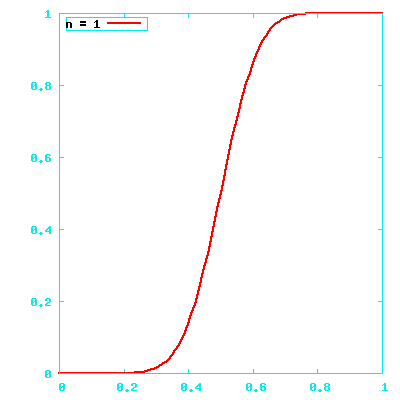
* Two elements ∈ -1.0..1.0
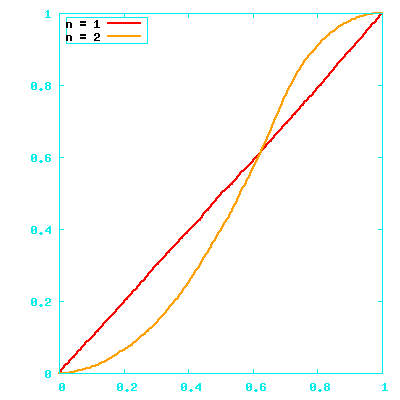
i
The a
is making up |a| tend to average out.
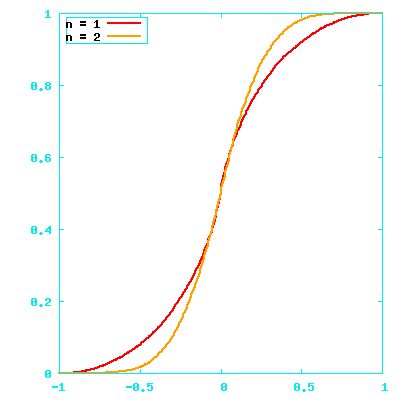
The a
i⋅b
i terms tend to cancel out
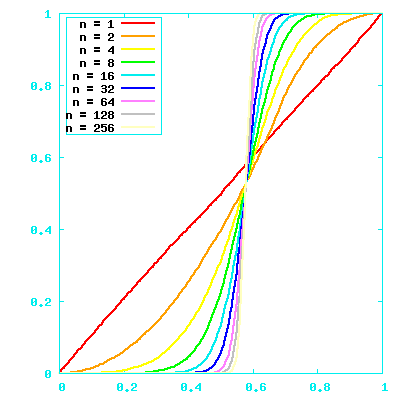
|a| is generally pretty close to (√n)/2
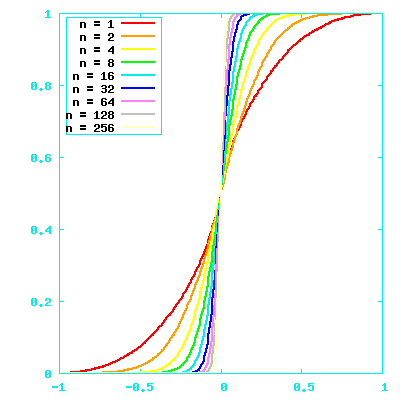
a⋅b is generally pretty close to 0
# Values in {-1,1}
* In one dimension, it's [1] or [-1]
- |a| is always 1
- a⋅b is 1 or -1
* In two, it's ∈ { [1,1], [1,-1], [-1,1], [-1,-1]}
- the corners of a square
- |a| is √2
- a⋅b/|a||b| = 1 for 1/4, 0 for 1/2, -1 for the other 1/4
* In general
- the corners of a hyper-cube
- |a| is √n in n dimensions
- The dot product will distribute as (k n)
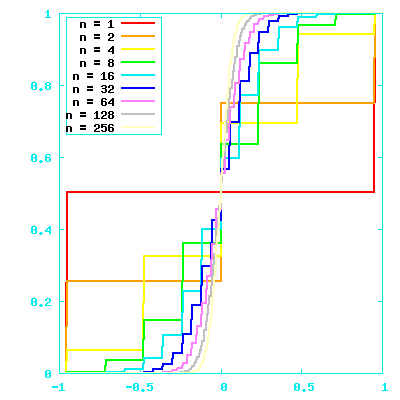
# Values ∈ {-1,1}, graphically
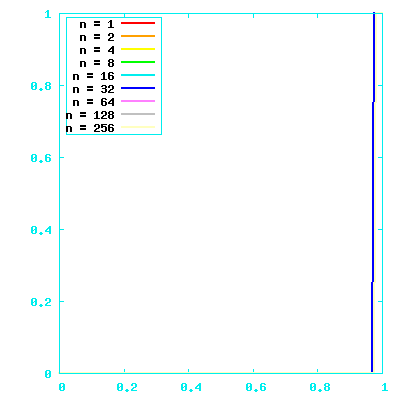
Loosely speaking, it looks a lot like the continuous case.
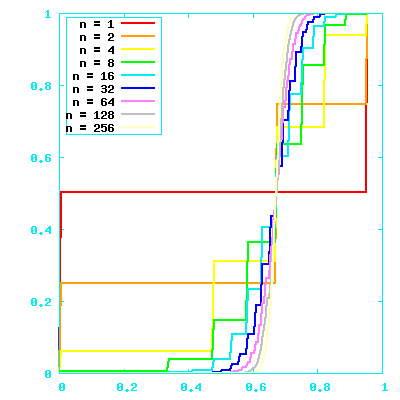
# Values in {0,1}
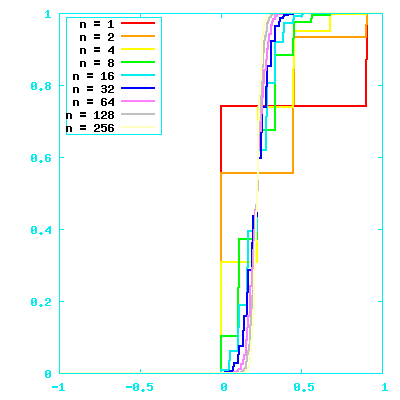
# Values in {0,1}, with 1s rare compared to 0s
# Shameless sweeping generalization
There are scads of other options
* {-1,0,1}
* {0,1,2,3,...255}
* {±1, ±1/2, ±1/3...}
* etc.
But when n gets large we pretty much always have:
* |a| ≈ some constant (most of the time)
* a⋅b ≈ 0 (most of the time)
# So what could we do with these?
Or better, what couldn't we do with them?
* Write abstruse papers for obscure journals
* Wrap fish
* Quantum mechanics
* Use them as GUID (for G ≠ "Global")
* Waste memory
* Concoct goofy presentations
# Fun cross product facts
* a×b = [ a2b3-a3b2, a3b1-a1b3, a1b2-a2b1 ]
* if a⋅ b = 0 and c = a×beta we can find c from a & b, b from a & c, and a from c & b
* Doesn't make sense except when n = 3
- Beyond quaternions
- If n is a multiple of 3 we can take the components in triples and write:
 a×b = [
a2b3-a3b2, a3b1-a1b3, a1b2-a2b1,
a5b6-a6b5, a6b4-a4b6, a4b5-a5b6,
a8b9-a9b8, a9b6-a7b9, a7b8-a8b7,
:
]
# Consider two object c and c'
* c' := c⋅(1-ε) + (a×b)⋅ε
* c' is pretty close to c ( c⋅c' ≈ |c|⋅|c'| )
* Given c' and a we can probably get b back:
(c'×a)/ε = c⋅(1-ε)×a/ε + (a×b)×a ≈ 0 + b
# One way to read this:
* c = an object
* a = a property name
* b = a value
* c' = "an object mostly just like c but if we ask it for something like a we'll get back something like b"
* c.a := b ⇒ c ← c⋅(1-ε) + (a×b)⋅ε
* c.a ⇒ (c'×a)/ε = c⋅(1-ε)×a/ε + (a×b)⋅×a
# TNSTAAFL
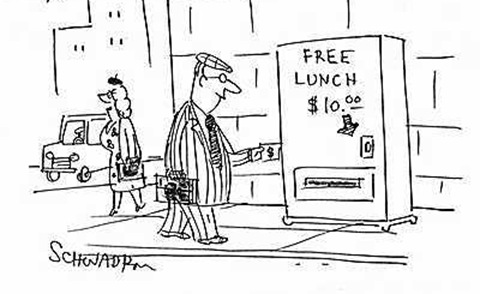
# But wait, there's less!
c.a := b
c.a := d
c.a ⇒ b ∪ d
Starting over with e instead of c, we could try:
e.a := b
e.a := ¬b (-1⋅ the vector representing b)
# Key encoding
Instead of:
c.a := b ⇒ c ← c⋅(1-ε) + (a×b)⋅ε
we probably really want something like:
c.a := b ⇒ c ← c⋅(1-ε) + ((a×1k)×2b)⋅ε
Where ×1 and ×2 are cross-product analogues with different partitionings and k is an arbitrary vector.
This lets us distinguish c.a := b from c.b := a.
# Other reasons to structure the keys
* We can code more information in the linkage; by using different "k"s we could distinguish things like:
* Keys
* Indexes
* Methods
* Instance variables
* By "scrambling" like this we can also deal with cases where the key (or value) is the object itself.
# The null key encoding
So what does the null-encoding
c' = c⋅(1-ε) + b⋅ε
mean?
The a has dropped out entirely, and in general c' will have the same properties c had. Only on issues where c is mute will b have any impact.
# Levels of interpretation
* Oth order: Color = (Red,Yellow,Blue)
* 1st order: struct { int x; int y; }
* 2nd order: javascript, anyone?
* Where next?
* Smalltalk/Ruby inheritance
* Matt's favorite, FSMs
* Extending ¬ to genera & difference
* Turtles all the way down
# Relationships are objects
* A bare relationship is a triple {subject, role, value}
* But this is just a vector
* The role component has inheritance
... relative ← ancestor ← grandparent ← grandmother ...
* Relationships can be more structured (frames)
* [the sum of 1 and 2 is 3]
* Movie tropes
* Can be written as Prolog
* This is Matt's soup!
# Skipping a few hours of material
a×b = [
a2b3-a3b2, a3b1-a1b3, a1b2-a2b1,
a5b6-a6b5, a6b4-a4b6, a4b5-a5b6,
a8b9-a9b8, a9b6-a7b9, a7b8-a8b7,
:
]
# Consider two object c and c'
* c' := c⋅(1-ε) + (a×b)⋅ε
* c' is pretty close to c ( c⋅c' ≈ |c|⋅|c'| )
* Given c' and a we can probably get b back:
(c'×a)/ε = c⋅(1-ε)×a/ε + (a×b)×a ≈ 0 + b
# One way to read this:
* c = an object
* a = a property name
* b = a value
* c' = "an object mostly just like c but if we ask it for something like a we'll get back something like b"
* c.a := b ⇒ c ← c⋅(1-ε) + (a×b)⋅ε
* c.a ⇒ (c'×a)/ε = c⋅(1-ε)×a/ε + (a×b)⋅×a
# TNSTAAFL

# But wait, there's less!
c.a := b
c.a := d
c.a ⇒ b ∪ d
Starting over with e instead of c, we could try:
e.a := b
e.a := ¬b (-1⋅ the vector representing b)
# Key encoding
Instead of:
c.a := b ⇒ c ← c⋅(1-ε) + (a×b)⋅ε
we probably really want something like:
c.a := b ⇒ c ← c⋅(1-ε) + ((a×1k)×2b)⋅ε
Where ×1 and ×2 are cross-product analogues with different partitionings and k is an arbitrary vector.
This lets us distinguish c.a := b from c.b := a.
# Other reasons to structure the keys
* We can code more information in the linkage; by using different "k"s we could distinguish things like:
* Keys
* Indexes
* Methods
* Instance variables
* By "scrambling" like this we can also deal with cases where the key (or value) is the object itself.
# The null key encoding
So what does the null-encoding
c' = c⋅(1-ε) + b⋅ε
mean?
The a has dropped out entirely, and in general c' will have the same properties c had. Only on issues where c is mute will b have any impact.
# Levels of interpretation
* Oth order: Color = (Red,Yellow,Blue)
* 1st order: struct { int x; int y; }
* 2nd order: javascript, anyone?
* Where next?
* Smalltalk/Ruby inheritance
* Matt's favorite, FSMs
* Extending ¬ to genera & difference
* Turtles all the way down
# Relationships are objects
* A bare relationship is a triple {subject, role, value}
* But this is just a vector
* The role component has inheritance
... relative ← ancestor ← grandparent ← grandmother ...
* Relationships can be more structured (frames)
* [the sum of 1 and 2 is 3]
* Movie tropes
* Can be written as Prolog
* This is Matt's soup!
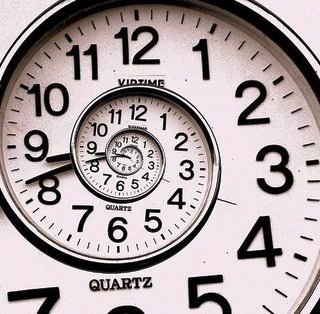
# Skipping a few hours of material
 # Bootstrapping the soup
* Assign a random vector to each thought/concept/category
* Using the declared structure as a guide
* Iteratively adjust the vectors
* Stop when they represent the desired structure
# Refinements
* Let them move a lot at first (large ε) and cool down as they converge
* Lock the structure eventually in with a small ε
* Or use the template to form standing waves
* Introduce thoughts incrementally and have old thoughts move more slowly
# Final outcome is basically the same
What you get is a density function over a Hilbert space.

# So where does that leave us?
* Spaces are composable
* Neighbors
* Lots of them:
- i = 1, n = 2, |{r ≤ i}| = 2
- rises roughly as in with some πs
* Very minor (but meaningful) differences
* Easy dot product circuit
* Find by pattern / unification / matching
* Analogues to modal reasoning models (temporal, counterfactual, intensional, provisional, etc.)
* Failure modes suggestively similar to known human mental failure modes.
# Finding our way in the soup

# What does this mean?

# How about this?
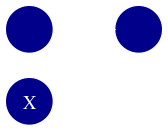
# But this, on the other hand:
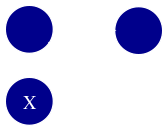
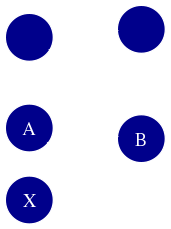
# One possibility
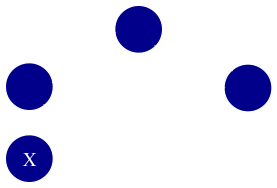
# The other
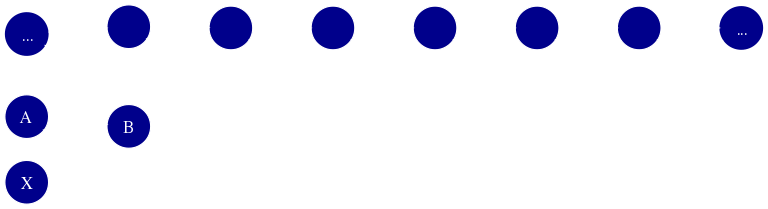
# We'll probably see things like this
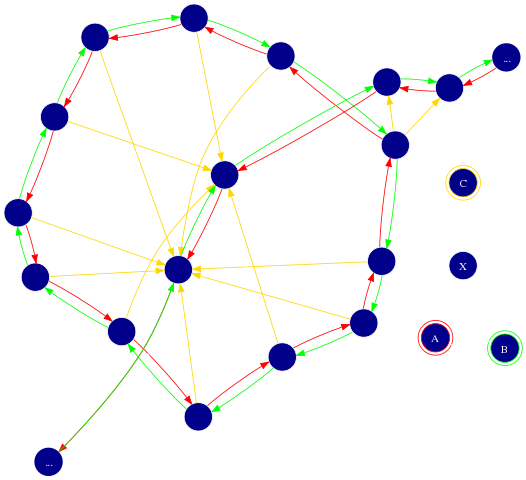
# And this
# Bootstrapping the soup
* Assign a random vector to each thought/concept/category
* Using the declared structure as a guide
* Iteratively adjust the vectors
* Stop when they represent the desired structure
# Refinements
* Let them move a lot at first (large ε) and cool down as they converge
* Lock the structure eventually in with a small ε
* Or use the template to form standing waves
* Introduce thoughts incrementally and have old thoughts move more slowly
# Final outcome is basically the same
What you get is a density function over a Hilbert space.

# So where does that leave us?
* Spaces are composable
* Neighbors
* Lots of them:
- i = 1, n = 2, |{r ≤ i}| = 2
- rises roughly as in with some πs
* Very minor (but meaningful) differences
* Easy dot product circuit
* Find by pattern / unification / matching
* Analogues to modal reasoning models (temporal, counterfactual, intensional, provisional, etc.)
* Failure modes suggestively similar to known human mental failure modes.
# Finding our way in the soup

# What does this mean?

# How about this?

# But this, on the other hand:

# One possibility

# The other

# We'll probably see things like this

# And this